Myths and Monoliths: Unpacking the Names Behind Eight Famous Whiskey Brands
You've probably seen names like Evan Williams and George T. Stagg on whiskey labels. But who were these historical figures, and what importance do they have to whiskey?
Rich Manning · Nov 04, 2026
If you're a whiskey drinker, you are probably familiar with the myriad of names that you see on bottles, sometimes with faces to match. But it can be a bit confusing as to who these historical figures actually were, and what their actual importance—or lack thereof—in the whiskey industry was. You may know that a particular moniker was attached to a real person, but that may be where the knowledge ends. Digging deeper into who these people were reveals a fascinating treasure trove of truths, myths, and stories that somehow manage to land somewhere in between. We’ve put together a guide to some of the most famous names in American whiskey, with some key info that can help you separate fact from fiction.
Elijah Craig
“Father of Bourbon” graces the front of every bottle of Elijah Craig. The claim is in reference to the namesake Baptist minister who’s credited as being the first distiller to age whiskey in new charred oak barrels. It’s a bold statement that’s meant to capture attention, but it’s not actually the truth. According to many historians, people in Kentucky were aging whiskey in charred oak before Craig popularized the practice. Still, an argument can be made to push this technicality aside and give him the patriarchal title regardless, because his efforts as a distiller and an entrepreneur helped spread the gospel of Kentucky’s fledgling spirits industry.
Michter’s
In a way, Michter’s is the Schroedinger’s cat of whiskey naming conventions, in that it’s arguably named and not-named after someone (it’s also the latest moniker of a brand that has been known by many names over the years). Originally called Shenk’s when John Shenk founded the distillery in Pennsylvania in 1753, its name was changed to Bomberger’s in the mid-1800s after Abraham Bomberger acquired the operation. It stayed that way until the mid-1950s, when entrepreneur Lou Forman bought the distillery and named it Michter’s, a totally made up portmanteau derived from a mash-up of his two sons’ names, Michael and Peter. It’s quirky, but it works because it just sounds right.
Old Fitzgerald
Old Fitzgerald gets its name John Fitzgerald, a person who’s somehow both myth and man. The “fake” Fitzgerald is the creation of Charles Herbst, a spirits dealer who owned a stake in a Kentucky bourbon distillery. The story goes that John was a bonded U.S. Treasury “gauger” tasked with levying distillery taxes based on inventory. He also had a highly discerning palate and a reputation for occasionally helping himself to the best stuff in Herbst’s warehouse. His whiskey thievery inspired Herbst to refer to any barrel of excellent quality as a “Fitzgerald.” Today, the brand is owned by Heaven Hill, and its name functions as a cheeky homage to the real Fitzgerald’s whiskey kleptomania.
Weller
Weller’s namesake, William LaRue Weller, is unequivocally one of the most important figures in bourbon history, particularly if you’re a collector. The Kentucky native and military veteran launched the brand W.L. Weller & Brothers in 1849 and immediately began tinkering. One of his experiments involved swapping out rye with wheat in the mashbill, paving the way for the softer, rounder expression that’s the backbone of some of the world’s most sought-after bourbons (like Pappy Van Winkle). While there’s some smattering of debate over Weller being the first distiller to pull this off, his status as the wheated whiskey pioneer of record is generally treated as industry canon.
E.H. Taylor, Jr.
The name gracing E.H. Taylor’s bottles is short for Colonel Edmund Haynes Taylor, Jr., a man whose designation as the “Father of the Modern Bourbon Industry” is justified. Taylor purchased the O.F.C. Distillery (now Buffalo Trace) in 1869 and fundamentally altered bourbon production in ways now easily taken for granted. He introduced innovations like copper fermentation tanks and column stills to the bourbon world. He redesigned building layouts for better cleanliness and production flow. He improved the efficiency of sour mash fermentation. Politics was also quite literally in his DNA—he was a descendent of President James Madison and the grand-nephew of President Zachary Taylor—and his foray into the political realm led him to advocate for the passage of the Bottled in Bond Act of 1897.
Stagg
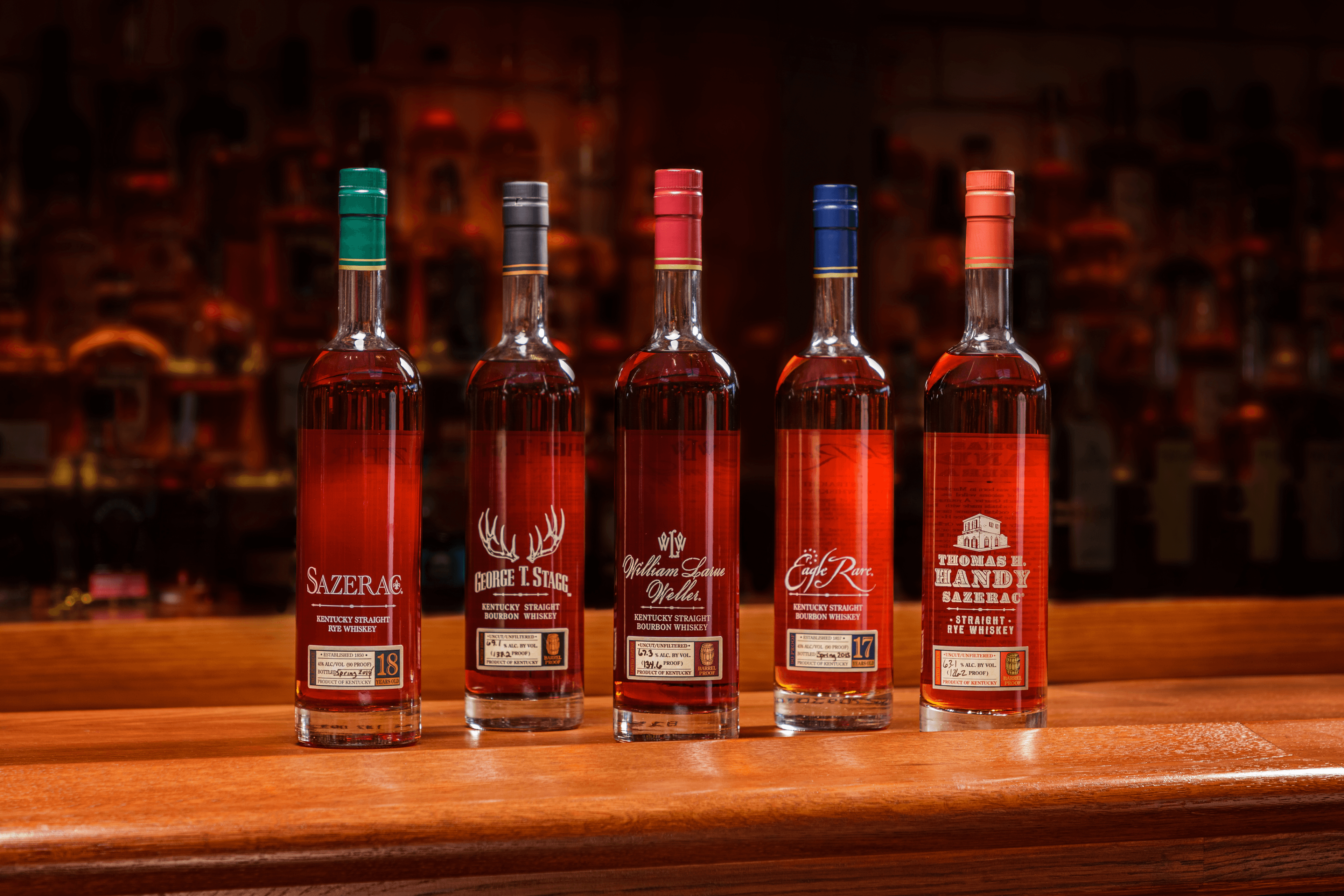
You can’t really explore the name E.H. Taylor without concurrently digging into the history of George T. Stagg, the man who inspired the name of Stagg bourbon. That’s because the two men’s legacies are forever intertwined thanks to a beef. Taylor and Stagg initially got along, but they grew to hate each other after Stagg took a controlling interest over O.F.C. Distillery due to Taylor’s financial problems. But there’s much more to Stagg’s bourbon story than being Taylor’s adversary. Stagg, who would eventually change the distillery’s name to George T. Stagg & Co., introduced climate-controlled warehouses, modernized the business side of distilling through improved record-keeping and quality control, and built an expansive distribution network. He died a few years after the rebranding, but his work ultimately left one of the most indelible marks in bourbon history—one that endures today through his distillery’s contemporary moniker, Buffalo Trace.
Evan Williams
You can thank Evan Williams (the person) the next time you pick up a bottle of his namesake bourbon, or any other bourbon, from your local bottle shop. Before the Welsh-born Williams opened his distillery in Louisville along the banks of the Ohio River in 1783, Kentucky bourbon was exchanged locally via the barter system or potentially sketchy means like unregulated jugs at neighborhood taverns. Williams changed all this by opening what is generally considered the first commercial distillery in Kentucky, setting the framework for acquiring bourbon by less dubious means. The distillery also added the stability bourbon needed to evolve into the bona fide spirits category it is today.
Blanton’s
The legacy of Colonel Albert Blanton reveals a snapshot of resiliency and perseverance amid some of Kentucky bourbon’s darkest times. Originally hired by George T. Stagg distillery at just 16, Blanton ascended to distillery president in 1921—quite possibly the worst time to do so, thanks to Prohibition. He kept the distillery going throughout the entirety of the Noble Experiment by acquiring a medicinal whiskey license from the government. In 1937, he brought the distillery back online a mere 24 hours after a near-apocalyptic storm completely flooded the facilities. During World War II, he grew the distillery even as he agreed to the federal government’s request to halt bourbon production and supply pure alcohol for the American war effort. (For the record, Blanton was a Kentucky Colonel, not a military one).
extendedBiddingModal.title
extendedBiddingModal.subtitle
extendedBiddingModal.paragraph1
extendedBiddingModal.paragraph2