Japanese Bar Owner Koji Nomura on the Early Years of Collecting Bourbon, Meeting Whiskey Legends, and Selling His Collection
We spoke to Nomura about his frequent trips to Kentucky in the early 2000s to hunt down rare bottles, meeting legendary whiskey figures, and figuring out how to ship all of those bottles back to Japan.
The Unicorn Review Editors · Sep 04, 2026
Koji Nomura is auctioning off a huge collection of the vintage bourbon he's collected over the past quarter century, but he still has plenty of bottles back at home in Japan to enjoy. He started traveling to Kentucky with his wife back in 1999, renting a car and driving around to different distilleries to soak up as much information about bourbon as possible—and soak up some of the liquid itself. Over the years, he made some good friends here in the States who would help hunt down bottles for him and send them overseas. Most of these found their way to his bars, Bar Sal’s and Craftheads, which became well known as whiskey havens. He recently decided it was time to clear out some space, but his decision to downsize means that an incredible collection of vintage American whiskey is now available here at Unicorn for you to bid on.
The following interview has been edited for length and clarity.
The Unicorn Review: When did you start collecting?
Koji Nomura: My bar is called Bar Sal’s (we kind of change names every 10 years, but it's basically the same place). My wife and I opened it in 1999, and we started off not even close to what we are now. We opened with some beers and maybe two or three bourbons, making about 500 yen, or about five bucks, per shot every night. We didn't know anything about the bar business. It was a corner bar, a mom-and-pop joint. We thought it might last a year.
What were some of the early bottles that you had at the bar?
Wild Turkey, Jack Daniel’s, Jim Beam, stuff like that. We didn't think the bar would last six months or a year. It was just a private place that my motorcycle could fit in, kind of like a garage. But we kept on buying bottles every night with the cash that came in. So after 100 days, we had 100 bottles. We didn’t know shit about bourbon, but we kept on buying bottles.
I have to know more about bourbon if I'm gonna keep on selling it.
Did you carry special Japanese exports?
I don’t think so. We would just walk into a local liquor store and buy whatever I didn’t have. After a year of collecting bourbon, I said, “I have to know more about bourbon if I'm gonna keep on selling it.” So the first time I went to Kentucky was around 2000. I just drove up to a distillery, probably in Louisville or Bardstown, and said I want to take a tour.
What was the first distillery you went to?
I don’t remember. I had these paper maps, and I circled all the distilleries and just drove around in a rental car. At that time, security would let anybody in. It was a peaceful time in 2000. They said, “You're from Japan? Just walk into the office, ask questions, take photos if you want.” They didn't have many visitor centers or tour guides or anything.
Were you able to buy bottles and bring them back to Japan?
On our first trips, we would go to Liquor Barn in Kentucky. We checked phone books and all the liquor stores around, buying bottles that you never saw in Japan. The yen was pretty good then. Two or three times a year, I went to Kentucky. We really traveled—renting a car, driving, going to liquor stores, interviewing, taking photos, getting to know bourbon.
Can you talk about meeting some of the old-school bourbon guys like Fred Noe and Julian Van Winkle?
Every time I went to Kentucky, I asked people about the history and about how to make bourbon. We hooked up with guys like Chuck Cowdery and Mike Veach. The straightbourbon.com guys were really helpful too. Most of the time, me and my wife just drove up and met the master distillers. They really taught us about bourbon. Like I said, I went there three times a year, so they'd go, “Koji, are you back again?” They’d take me into the back offices, warehouses, tasting rooms, and show me all this paperwork. They kept on showing us because at the time, bourbon was good, but it wasn’t selling.
In Japan, if there were 100 scotch bars, there were probably five bourbon bars.
What was the demand for bourbon like in Japan back then?
In Japan, there were so many single malt scotch bars. Scotch whisky was a sophisticated drink like wine. Scotch was for the cigar people, the people who play golf, you know what I mean? It was the sophisticated, high-class drink. In Japan, if there were 100 scotch bars, there were probably five bourbon bars. I thought it was pretty cool doing bourbon instead of scotch. But I wasn't the kind of guy who was driving around in a Mercedes Benz.
In the ‘80s and the ‘90s, Japanese whiskey importers bought overstocked bourbon from the States—20-year-old, 16-year-old, 18-year-old, 25-year-old. But I don't think anybody was that interested in bourbon. It wasn't a big market. If it was, we wouldn't have those dusty bottles in my collections right now. They would have been all sold. And it was a great way to get those old barrels out from the warehouses in the U.S. because nobody was buying it in the U.S. at that time.
There weren’t many fake bottles in the market because it was all cheap.
Did you think bourbon would make a big comeback and these bottles you're collecting would be incredibly valuable someday, or did that come as a surprise to you?
Before the internet, in the States or Japan, nobody knew what bottles were selling. When I started collecting bourbon and craft beer, you'd go to San Diego, Portland, Maine—nobody even knew how bourbon barrels were being used. So a guy from Japan knew more about barrels than most of the breweries in the States at that time. The internet, the information on straightbourbon.com, about dusty bottles, going to all these old liquor shops, it just spread.
Things were still buyable on eBay then—cheap, old bottles, dusty bottles. I bought a lot of these dusty bottles from eBay from the States. They just sent it out from the Post Office saying, “old bottle.” Those were good times. There weren’t many fake bottles in the market because it was all cheap. So you could buy any kind of old shit from some lady in the Texas region, and she’d send bottles to Japan.
At what point did people start coming to your bar to seek out vintage bottles?
Around 2009, I had more customers coming in from the States, so I opened up a bar in Shibuya in Tokyo. At the same time, the early 2010s, it was getting harder to buy all the BTACs and rare bottles, because I think it was catching up in the States. I quit going to Liquor Barn or buying bottles at Binny’s or Sam's, because even if I went there and I knew the guys at the shop, I couldn't get my hands on bottles. Nowadays, you couldn't amass a collection like this without spending tens of thousands, maybe 100s of thousands of dollars.
Did you have people in the U.S. helping you find bottles?
Yeah, the guys from straightbourbon.com helped a lot. When I couldn’t go and buy boxes of BTACs and all that, they helped me out, bought it for me, kept it for me. And then when the time came, they’d send me maybe 20, 30 bottles. So, yeah, friends really just helped me out.
Booker, Jimmy, the Van Winkles—they’re just nice guys who love barbecue and booze. They're regular people.
What were some of the highlights of you meeting some figures in the industry, like well-known distillers?
It's like meeting the stars. If you're not in the bourbon world, these people would just be regular people driving to the supermarket or walking around town. But when you're in this industry and you meet Booker, Jimmy, the Van Winkles, it’s different. But they’re still just nice guys who love barbecue and booze. They're regular people.
Did you get to meet Booker Noe?
I did, me and my wife. Only once, though, but he was great. I know his son, Fred. These people are really nice and they just want to talk about bourbon. And most of the time, if the distillery wasn't owned by a big company, they had no secrets about recipes and everything. They'd just tell you, “Look, nobody's gonna copy us anyway.” Everybody just explained everything. They didn't have any secrets.
Were there any brands or distilleries that you were particularly interested in collecting?
I have this obsession with Old Crow. At the beginning, I didn't know much about the history of Old Crow, but I liked the design. When I was a university student, I drank a lot of Old Crow and soda because it was cheap. I could stay in the bars longer, and you don't get really drunk because it's only 80 proof.
Now I have a really nice collection of Old Crow. I have four or five bricks from the Old Crow warehouse, from before it was taken down. I have one Old Crow bottle from 1901. It's a rye whiskey, actually, it's not bourbon. The whiskey was so good back then. And I have 64 of the Chessmen decanters. I have all these things surrounded by Old Crow in my bar too.
What are some of the most valuable bottles that you have in the auction?
Probably the Van Winkles. But I thought the most unique bottle was from Willet, the Rogin’s bottle. Rogin, he owns a bar in Osaka named Rogin’s Tavern. He never tells anybody about much of his collection, but It's probably number one in the world. Nobody really knows how much he's stocked up. But even the massive distillers in the States know if they want a specific bottle, they just email him and he has it in his warehouse. So his bottle was only one of, like, 100 bottles for the 25th anniversary, and it's a 25-year-old Willett.
If you know how to drink it, even a white label Jim Beam isn't that bad at times.
At your bar, what would you steer someone towards if they want to try some vintage whiskey?
If they're not a pro bourbon drinker, I'll explain how cheap Heaven Hill bottles are good, like, eight-year, maybe 12. Or even just a regular Buffalo Trace. If they know how to drink it, even a white label Jim Beam isn't that bad at times—if you have good ice and glassware and a good atmosphere in the bar.
What if somebody comes in and wants to drop some cash?
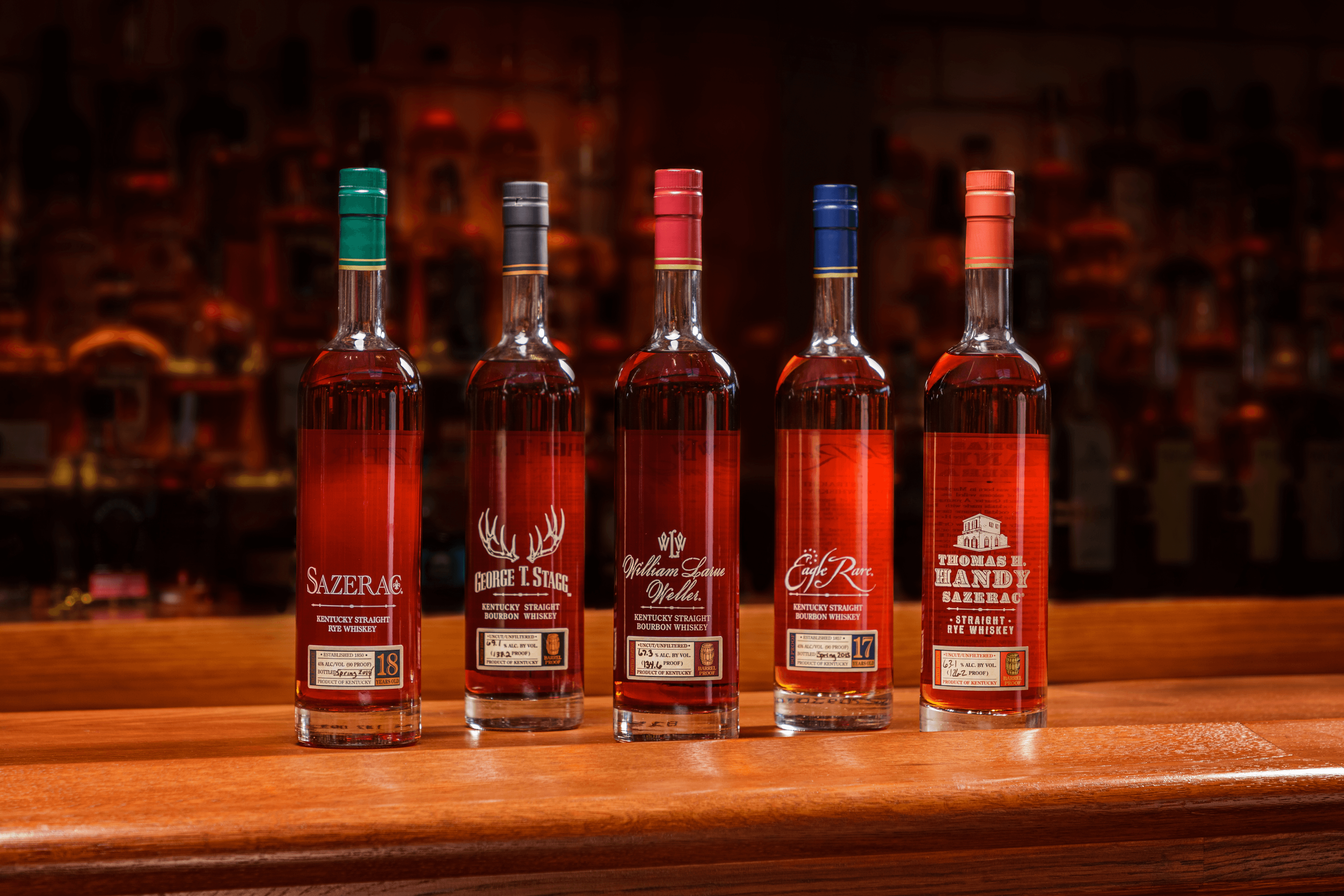
We always have some BTAC lined up, or the Old Crow Chessmen decanters, or even the 1968 10-year-old bourbon. Last night, a customer ordered Old Crow ‘68, Chessmen,, and then he went to the Handy BTAC. So he had a good time. But those are only about $20 a shot at my place. I try to explain that sometimes expensive is good, and low-price bourbon is always good.
What's the most expensive pour you have at the bar now?
We try to keep it always around $25 or $30 per ounce. The last time I had a pour for $80, that was from 1940-something, Kentucky Vintage. That was quite good, so nobody complained about that for 80 bucks. If they're rich enough, I wouldn't really mind taking the money. But when these customers come into the bar, I don't know how full their wallets are. I don't want to try to take all their money.
Always be a nerd about anything you collect. And, most importantly, only buy what you love.
Why are you selling off your bottles now?
This is probably half of my collection. I'm getting old, I’m close to 60 now. I have so many toys, camping equipment, and things in my garage. I'm doing auctions daily right now in my private life, selling all these action figures, comic books. At some point, you gotta clean up, it's time. But I'm not selling off everything, so it's not like I'm gonna quit bourbon.
The bar is still open. We still have a lot of dusty bottles, like J.W. Dant. We have some old Heaven Hill four-year-old or six-year-old from pre-fire. Those are gonna stay at my house. I don't know why, but people don't want to pay a lot of money for them because they’re not that famous. One day, I hope people realize it's not all about the high-end bottles.
What are your hopes for this auction, and what advice do you have for collectors?
I really hope the next generation of collectors will enjoy these bottles. I have duplicates of most, so I will still get to enjoy all of this whiskey myself! For future collectors, my advice would be to always buy and be a nerd about anything you collect. And, most importantly, only buy what you love.
extendedBiddingModal.title
extendedBiddingModal.subtitle
extendedBiddingModal.paragraph1
extendedBiddingModal.paragraph2